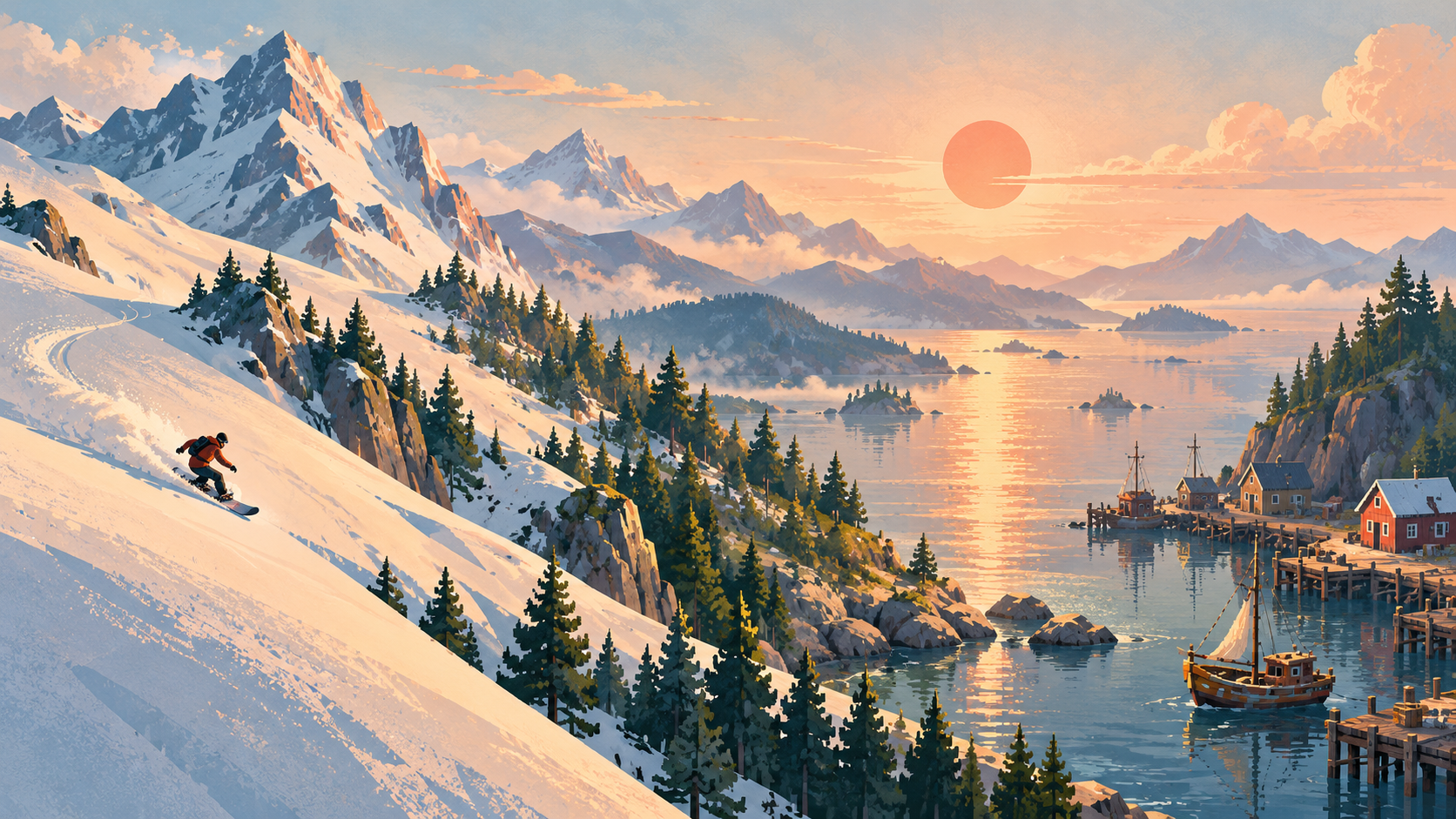
A small boat crosses a pale sea. Somewhere else, a snowboarder approaches a jump. Their worlds have different materials, rhythms and reasons to move. Yet both scenes ask a quiet question: what kind of afternoon is this?
Before we study a hull or judge a landing, light gives us an answer. It tells us whether the air feels clear, whether a surface turns toward us, and whether the distance feels welcoming or hard to read. For PixelBoats and Champions of Snowboarding, shared light is a promising design language: two distinct worlds can agree about what an hour feels like.
One afternoon, two surfaces
Imagine a low sun arriving from the left. The water warms. A boat's upper surfaces brighten while its far side falls into cooler shade. On the mountain, the same broad direction could round a bank and open up a landing.
The important word is “same.” A beautiful sky loses some of its authority when an object beneath it appears to belong to another time of day.
An October 3 source review found this mismatch in PixelBoats: its environmental lighting exposes sun and ambient information, while one vessel rendering pass uses a fixed light direction. Reconciling them remains work to explore. The design principle is that the world establishes the conditions, while each material responds in its own voice.
A wooden deck, water and snow need different responses. They can still share a sun.
Facets need a surface
Faceted art has a particular pleasure. A few planes can describe substantial form, with each change in tone making a small statement about shape.
In a basic Lambertian diffuse model, orientation affects how much incident light contributes. As Physically Based Rendering explains, the cosine factor appears in the light transport calculation. For an artist, the practical intuition is simple: turn a plane and its light response changes.
That intuition depends on having a surface direction to work with. The October 3 review found that the Champions of Snowboarding mathematical rider renderer already has face normals and shading, in a path separate from native play. Dividing a flat silhouette into triangles alone does not create three-dimensional form; the triangles can remain a flat drawing.
So which objects benefit from a stronger volume cue, and which should retain the simplicity of a graphic mark? Shared light can unify a scene without asking every object to use the same geometric technique.
Let the air participate
There is also the space between things. In physical rendering, fog and atmospheric particles can attenuate and scatter light along its path. The opening of Physically Based Rendering's volume-scattering chapter describes those effects.
A stylized game can borrow the visual lesson without simulating every particle. Distant boats might lose some contrast toward the horizon. Far ridges might gather into quieter colour bands, leaving the next turn crisp.
Here atmosphere becomes composition: detail recedes where it can, while immediate choices remain legible. A convincing evening still needs to let someone see where they are going.
Pictures that already remember the sun
Cached sprites introduce a subtle complication: a picture may already contain its lighting. Darken that image again as though it were an unlit surface, and two accounts of shade can overlap.
One possible tool is a normal map. Unity's manual describes normal maps as texture data used to vary surface direction for lighting calculations, without adding matching geometry. They need artwork prepared to work with that lighting; a normal map does not automatically remove shadows already painted into a sprite.
A small set of carefully authored lighting variants might be just as expressive. The right choice depends on how much the hour needs to change and how the original picture was made.
A family resemblance
Place a harbour scene beside a mountain scene at late afternoon. Their palettes need not match, and their rendering methods need not match either. Light alone could make them feel as if they belong to the same day.
That is an appealing kind of continuity: something a player senses before naming it. Two worlds can remain unmistakably themselves while sharing the hour.